
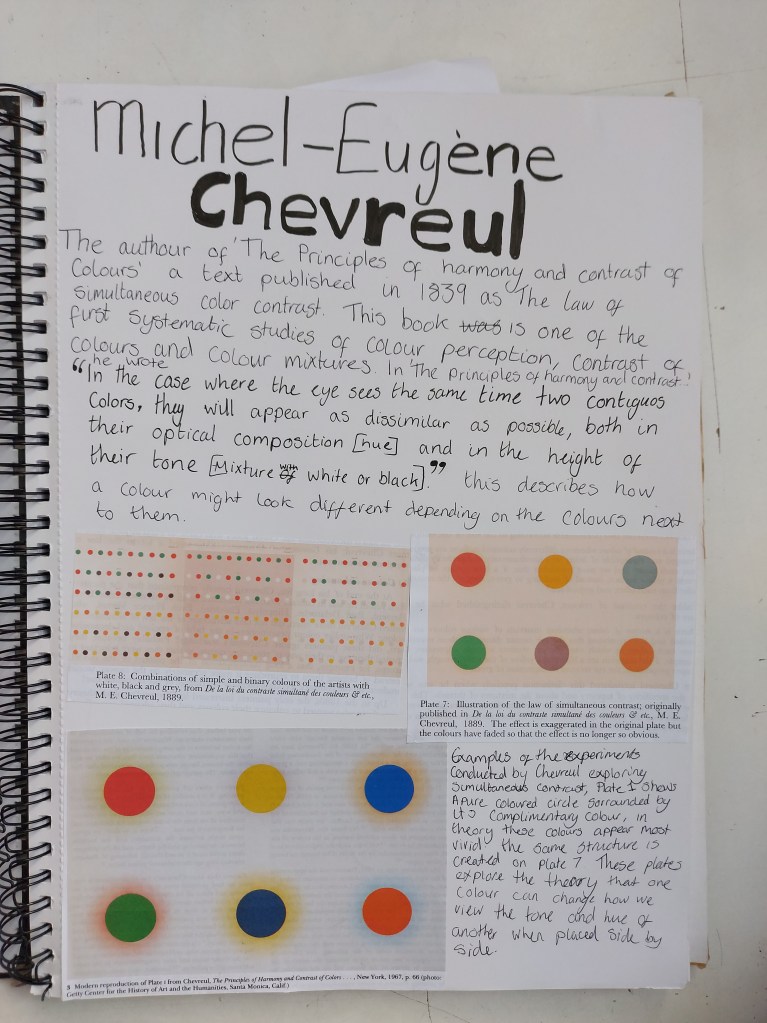
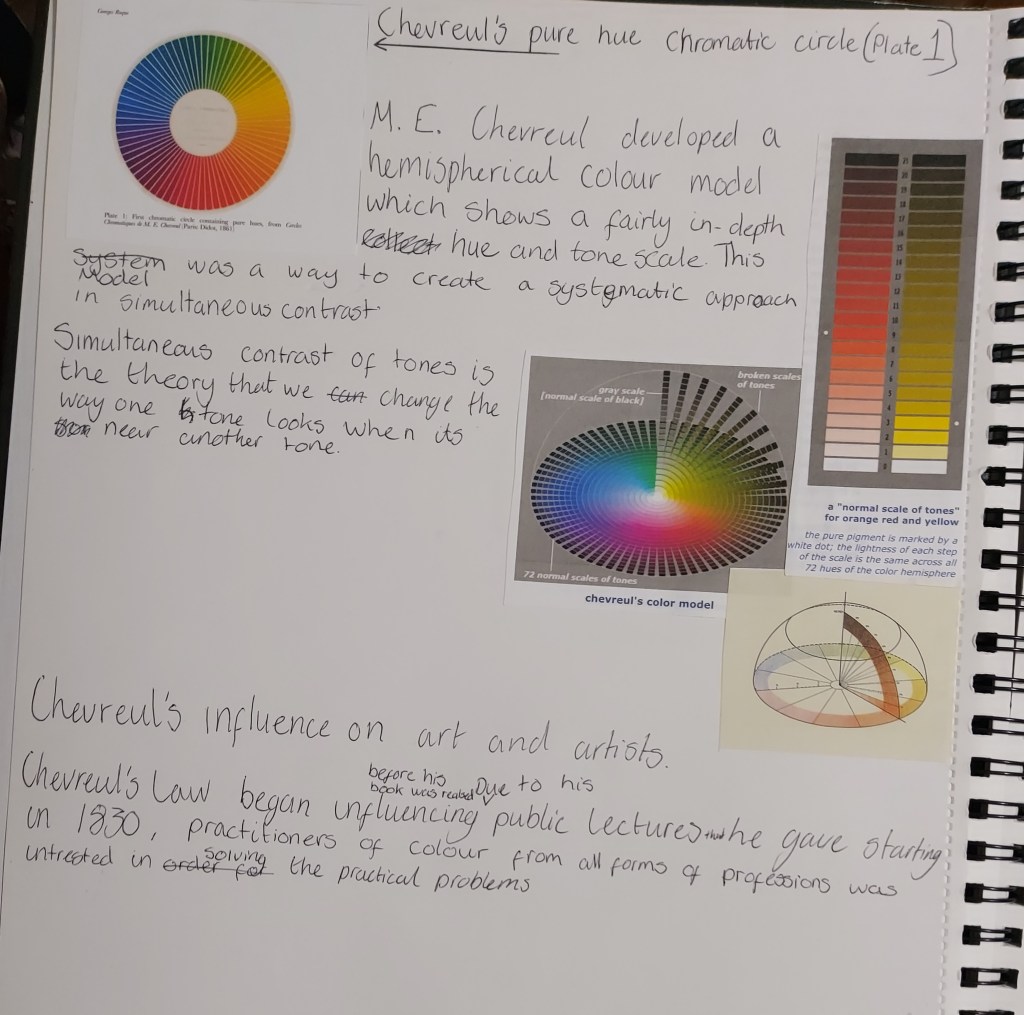
Michel-Eugene Chevreul is the author of ‘The Principles of harmony and contrast of colours’ a text published in 1839, its content was soon know as the laws of simultaneous colour contrast. This book is one of the first systematic studies of colour perception, contrast of colours and colour mixtures. In ‘The principles of harmony and contrast..’ Chevreul wrote, “In the case where the eye sees the same time two contiguous colors, they will appear as dissimilar as possible, both in their optical compositions [hue] and in the height of their tone [mixture with white or black].” This describes how a colour might look different depending on the colours next to them.
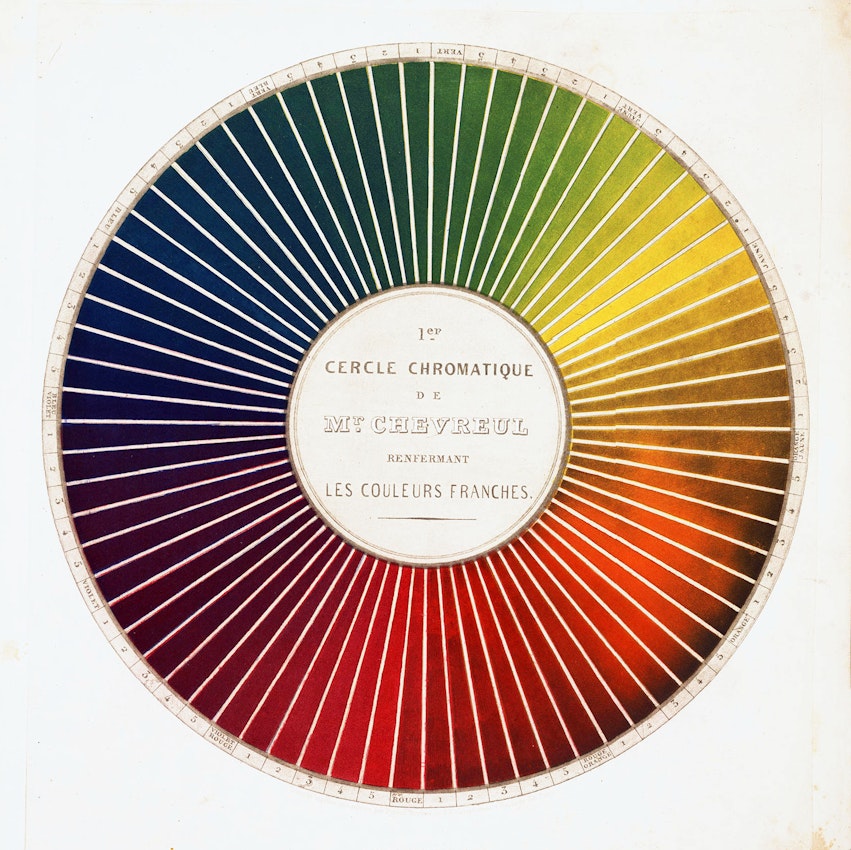
M. E. Chevreul developed a hemispherical colour model which shows a fairly in-depth hue and tone scale. This model was a way to create a systematic approach in simultaneous contrast. Simultaneous contrast of tones is the theory that we change the way tone looks when its near another tone.


Chevreul’s influence on art and artist
Chevreul’s law began influencing before his book was released due to given public lectures that he gave in 1830’s, practitioners of colour from all forms of professions was interested in solving the practical problems that can be found when layering colours together.
In painting by Claude Monet, a French Impressionist painter you can see use of Chevreul’s theory.

In The Poppy Field near Argenteuil (1873), Monet uses the simultaneous contrast techniques and juxtaposed complementary colours to give more intensity to the colours used. In this image we see the dark blueish green and a intense red allowing the viewer to see this theory in practice.
In The Magpie (1869), the vibrant blue shadows in the snow and the complementary yellow sunlight are the complementary tones in a very white painting. Using these tones and not black is an example of juxtaposed colours in nature as shadows do not appear to be black as many artists in history have depicted.
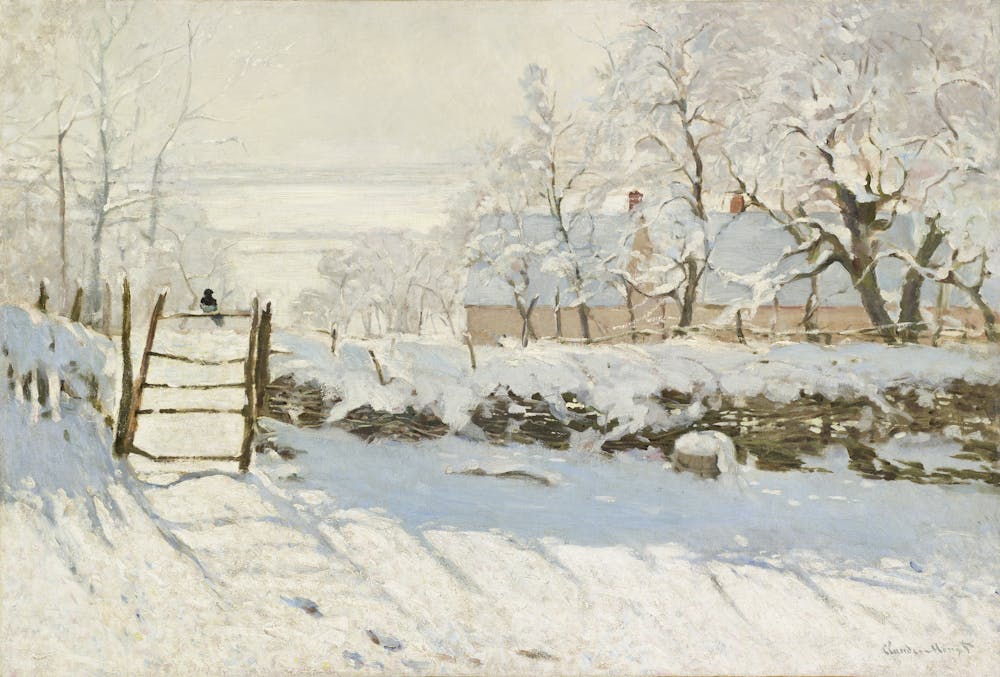
Claude Monet – The Magpies 1868–1869, Oil on canvas, 89 cm × 130 cm (35 in × 51 in), Musée d’Orsay, Paris
Vincent Van Gogh’s use of bright blues and yellow-oranges in the painting Cafe Terrace on the Place du Forum, Arles (1888) or the reds and green in Night Cafe in Arles (1888) show Chevreul’s law

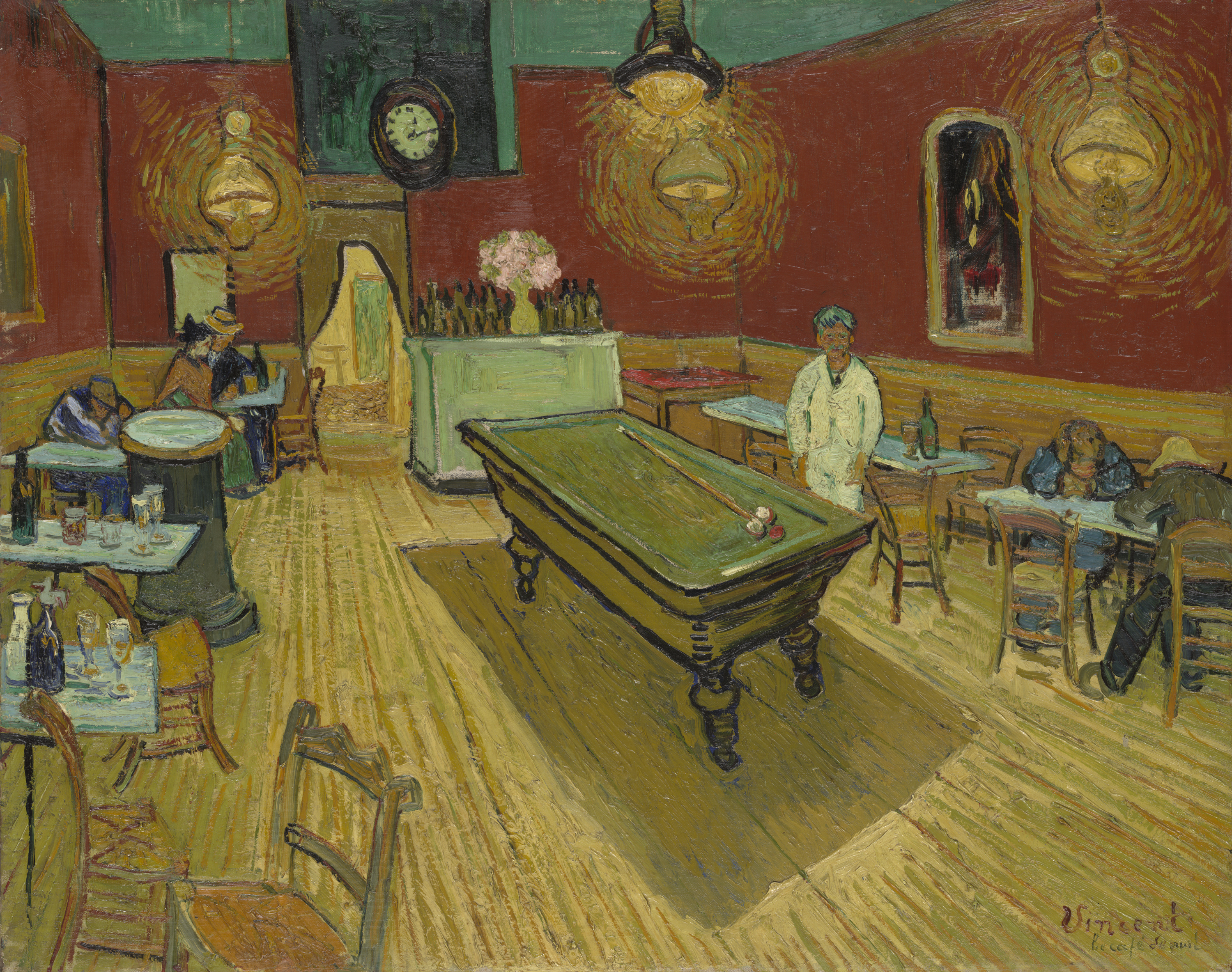
“The room is blood-red and dull yellow, a green billiard table in the centre, 4 lemon yellow lamps with an orange and green glow. Everywhere it’s a battle and an antithesis of the most different greens and reds; in the characters of the sleeping ruffians, small in the empty, high6 room, some purple and blue. The blood-red and the yellow-green of the billiard table, for example, contrast with the little bit of delicate Louis XV green of the counter, where there’s a pink bouquet.The white clothes of the owner, watching over things from a corner in this furnace, become lemon yellow, pale luminous green” (Van Gogh, 1888)
What I have learnt from Chevreul’s theories
In the future when choosing a palette, I will think about how adjacent colours affect one another. I will approach creating shadows in by looking at the tinted and muted complementary colours and look for ways to incorporate juxtaposed colours to create contrasts.
References – Bruce MacEvoy (May 2015) michel-eugène chevreul’s “principles of color harmony and contrast” Available at: https://www.handprint.com/HP/WCL/chevreul.html (Accessed: 05/05/2020)
the Colour Group Great Britain (June 2010) Chevreul’s Colour Theory and its Consequences for Artists Available at: https://www.colour.org.uk/publications/ (Accessed: 08/05/2020)
Van Gogh’s Letters – Van Gogh Museum – From: Vincent van Gogh To: Theo van Gogh Date: Arles, 8 September 1888 – Letter 676 Available at: http://www.vangoghletters.org/vg/letters/let676/letter.html (accessed: 08/05/2020)
 B-log
B-log 