
During the 17th Century for the Netherlands, is best known as The Dutch Golden Age. “..a unique era of political, economic, and cultyral greatness during which the little nation on the North Sea rank among the most powerful and influential in Europe and the world.” (Herbert, H. Roweil – 2020)
Still-Life (or stilleven) paintings was a dominant element in Dutch Art with numerous sub-types such as religious iconography, flower paintings, imitations of nature, kitchen and market paintings, breakfast and food table paintings and vanitas painting (symbolic work representing life, mortality and pleasure). Still lifes are a way to display a painters skills, highlighting on painting textures and surfaces in detail and realsium. As for the subjects these this often included extravagant banquets, silver and gold challisses and serving dishes. This images all have a message behind them, showcasing wealth and fortune.
Some notable Still Life and flowers Artists
Pieter Claesz 1597 – 1661 His still life range of subjects included simple breakfast settings with reflecting glass, metal objects painted in a largely monochromatic palette and vanitas paintings
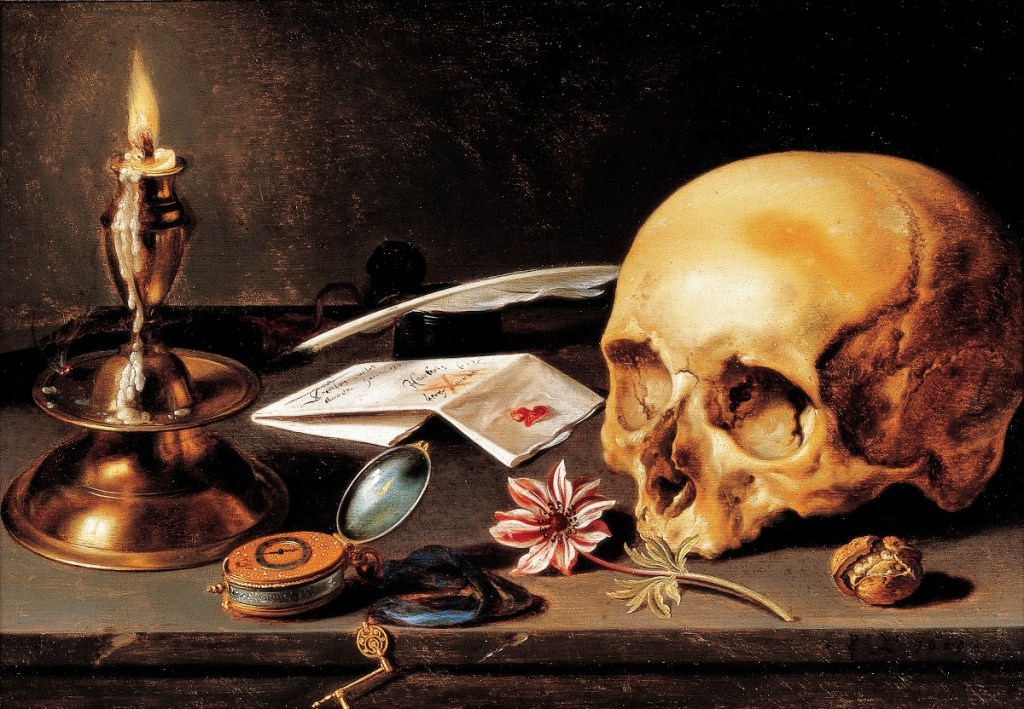
Pieter Claesz – Vanitas Still Life 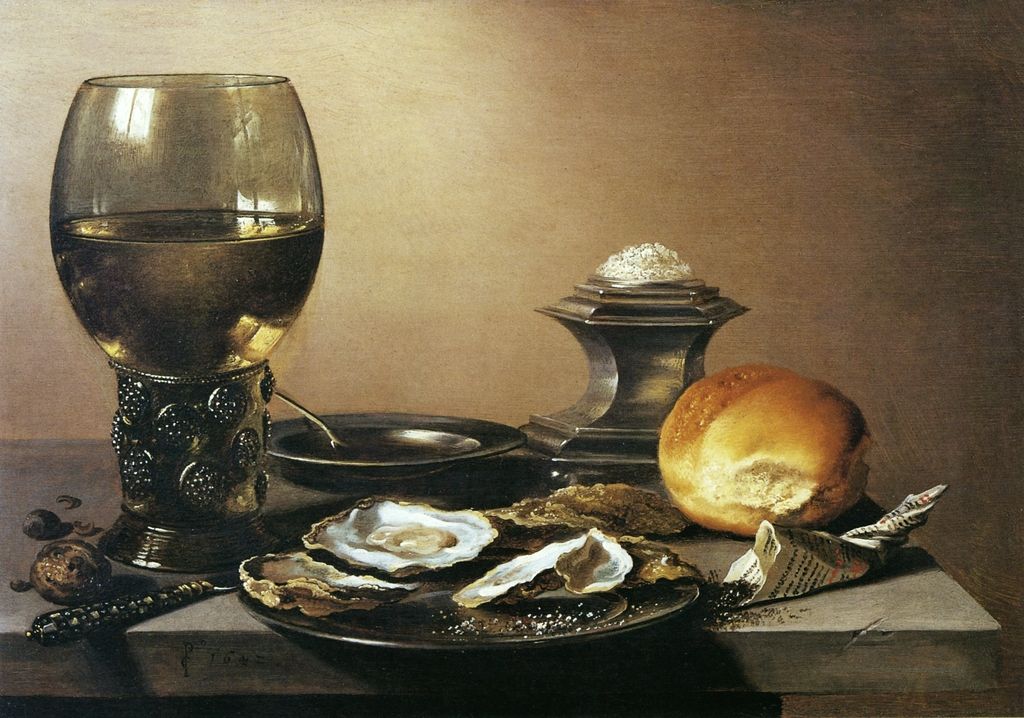
Pieter Claesz – Still life with oysters 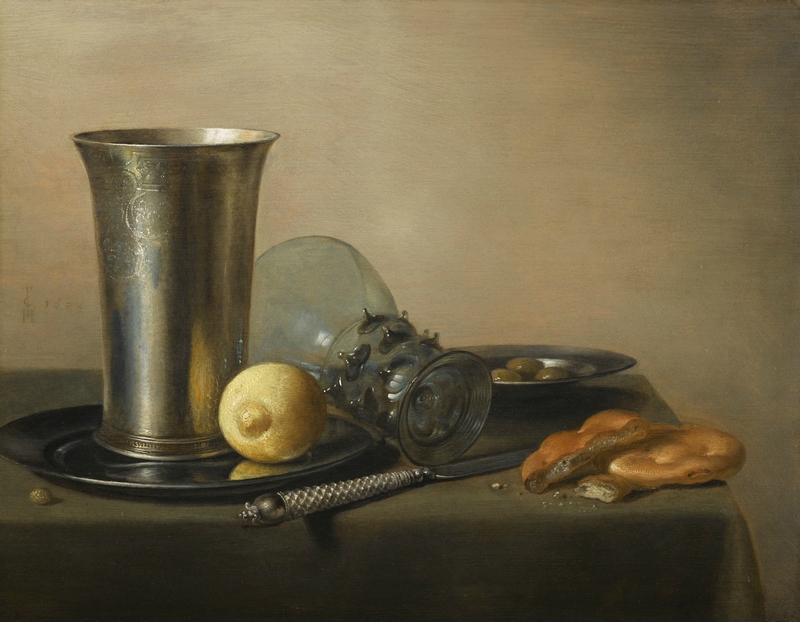
Pieter Claesz – Still life with a silver beaker and an overturned roemer, with bread, a knife and a lemon and olives on two pewter plates
Maria Van Oosterwych 1630 – 1693 would draw scientifically accurate colour sketches of plants, using illustrations or from nature throughout the years then create bouquets of flowers together from different seasons and locations. Her imaginary bouquet created beautiful paintings which are bright and rich in colour and many artworks she created included bugs, butterflies and bees.

Maria Van Oosterwych – Still Life with flowers and butterflies 
Maria Van Oosterwych – Still life with flowers, insects and a shell 
Maria Van Oosterwych – A bouquet of flowers in a vase
Willem Van Aelst 16 May 1627 – buried 22 May 1683 A member of the guild of flower painters. He had a baroque style. He used cool palettes of blues, mauves and greens. His floral arrangements are characterized by his asymmetrical and technical decorative nature.
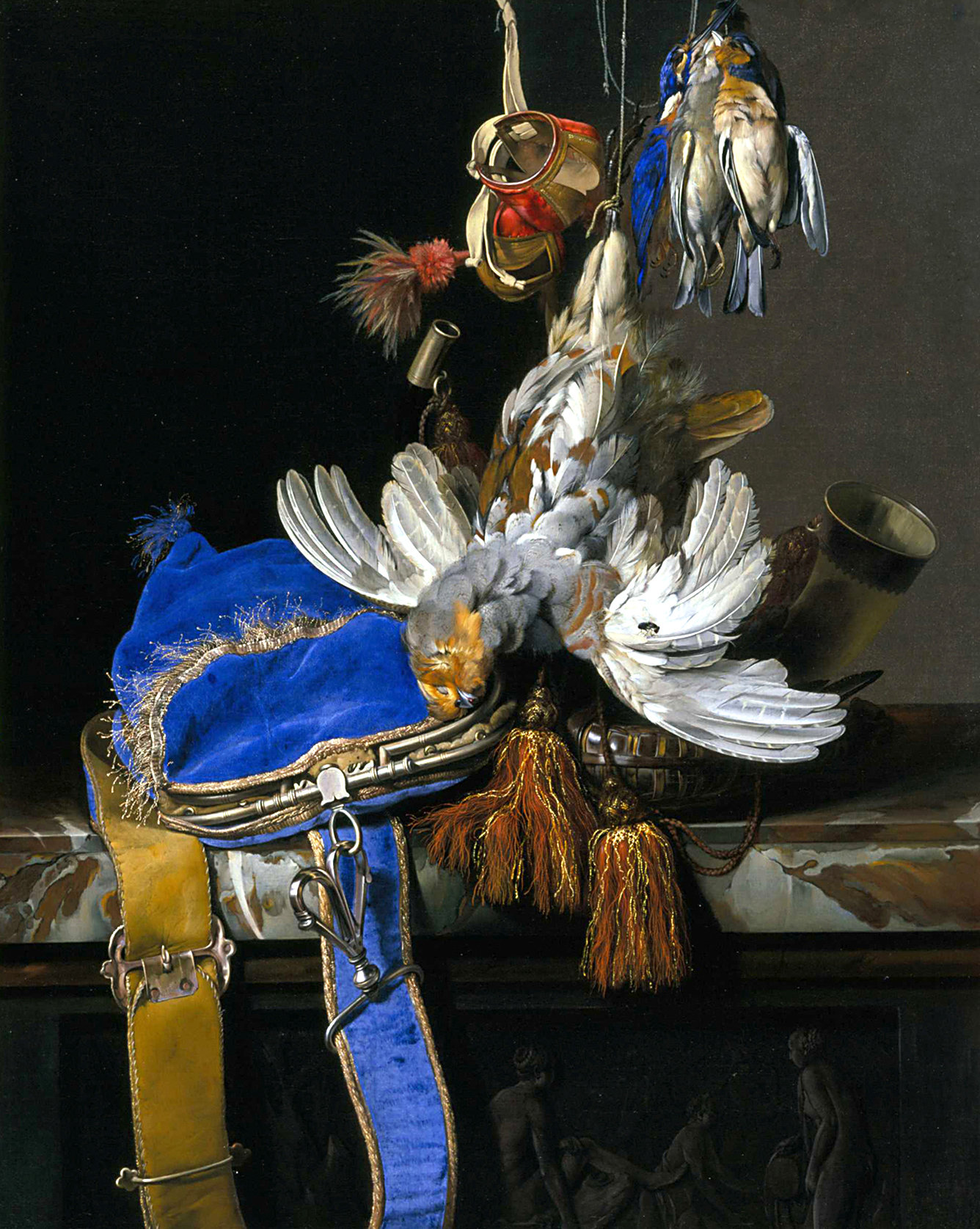
Willem Van Aelst –
Hunt Still Life with a Velvet Bag on a Marble Ledge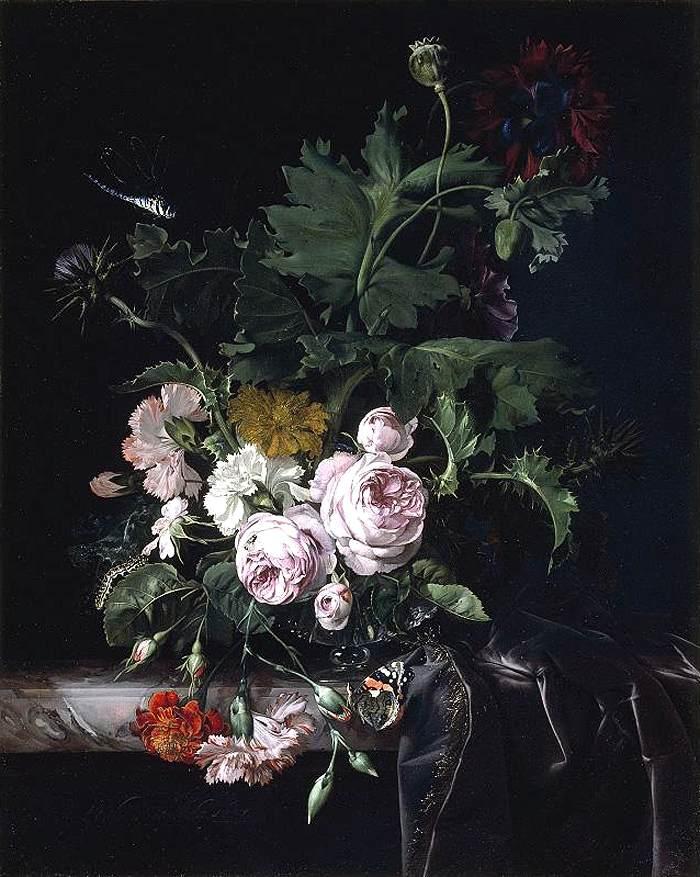
Willem van Aelst – Flower Still-Life 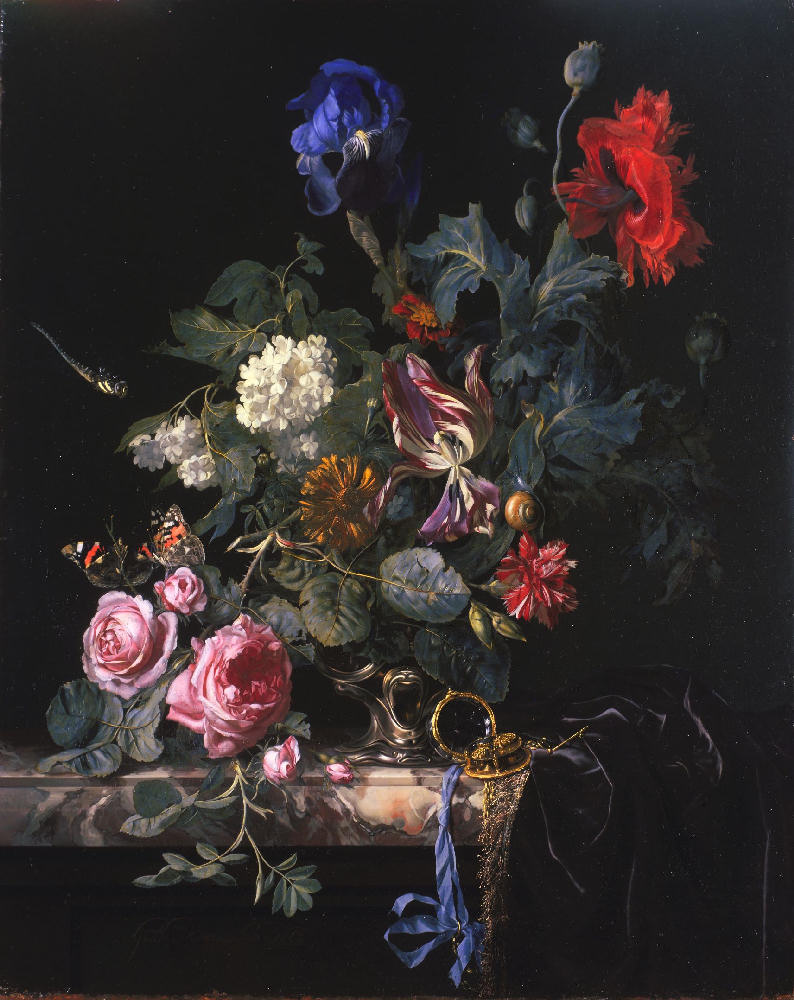
Willem van Aelst – Flowers in a Silver Vase
Rachel Ruysch 1664 – 1750 A flower artist who painted vibrant, delicate and accurately. As a child she painted flowers her father, a professor of bontany and anatomy, she apprenticed with van aelst until 1683. Her talent was noticed in her lifetime and she experienced fame. Ruysch is considered one of the most talented still llife artists.
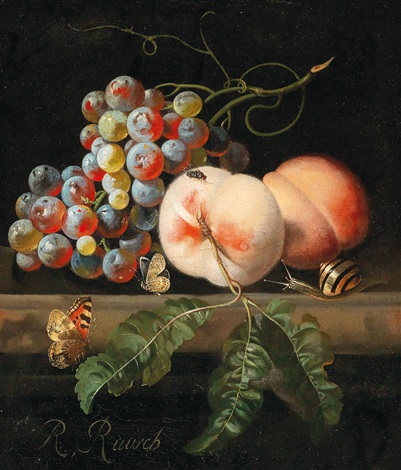
Unknown title 
Rachel Ruysch – Flowers, fruit, reptiles, and insects on the edge of a wood
Still Life development through the ages.
Edwin Steele 1803 – 1871 or 1837-1898 or 1861 – 1933 A 19th century Floral and Still life artist a worker at Rockingham china and porcelain we have found that Edwin Steele was a painter and enamaller at this factory. These painting appear to be brighter, well lit and carefully constructed to show the way things can be grouped together. His artworks can be viewed https://www.mutualart.com/Artist/Edwin-Steele/6E0633158D14214A/Artworks
Marianne North 1830 – 1890 A English victorian biologist and botanical artist. Noted for her plant and landscape paintings and plant discoveries. She displayed a talent for painting from an early age. Her paintings are vivid, accurate made during her extensive travels across her life. Link to her paintings http://www.kew.org/mng/gallery/index.html
Georges Braque 1882 – 1963 a major 20th-century French painter, collagist, draughtsman, printmaker and sculptor. Braque’s paintings had unique style, he is known as the founder of cubism along with Pablo Picasso. His still life works are a exploration of ways to represent reality. He provides different perspectives and obscure views to achieve the true likeness of an object. His early works follow a more naturalistic and fluid style, showing a subject traditionally. View his artworks here https://www.tate.org.uk/search?aid=803&type=artwork
Pablo Picasso 1881 – 1973 20th century influential painter who worked in a variety of styles. Born in Spain but spent most of his life in Paris. The creator along with Georges Braque of cubism. For nearly 80 of his 91 years, Picasso devoted himself to an artistic production. His still life works vary in style over the years, in the early 1900 Picasso’s works had a more traditional still life theme, composition, uses of contrast and simultaneous colours. His looser brush strokes give a slight immpressonist style. By 1910 Picasso had began exploring cubisum, showing complex hard edges, use of shadow and dark contrasts. Pablo also create further still life works in pointillism, tonal sketches, line, collage and even extending into three-dimensional space. His still life works are available here https://www.pablo-ruiz-picasso.net/theme-naturemorte.php and a example of his 3D still life https://www.tate.org.uk/art/artworks/picasso-still-life-t01136
Roy Lichtenstein 1923 – 1997 An American pop artist during the 1960’s His work defined the premise of pop art through parody. Inspired by the comic strip, Lichtenstein produced precise compositions that documented while they parodied, often in a tongue-in-cheek manner. His still life work showed objects in a unique cartoon style. He often created works using hard, vivid colours and ‘Benday dots’ to create dimension and tone. Here is a link to a installation of still life works by Roy Lichtenstein https://gagosian.com/exhibitions/2010/roy-lichtenstein-still-lifes/
Fred Barnfield 1935 – 2013 Lived and worked in the Tipton, West Midlands, England known The Black Country He was an artist, sculptor, writer and philosopher who has created quite a few styles. The most famous is blobology and barcodes. Barnfield’s art work is founded on numerous techniques, he copied the works of great artists in history in order to learn their artistic secrets. His still life work is all inspired by artists like Pablo picasso and show multipule techniques in one. View his paintings here https://artuk.org/discover/artists/barnfield-fred-19352013
Refernces
Encyclopædia Britannica. 2020. Netherlands. [ONLINE] Available at: https://www.britannica.com/place/Netherlands/Dutch-civilization-in-the-Golden-Age-1609-1713. [Accessed 23 August 2020].
 B-log
B-log 