
A self-portrait is an artists’ representation of themselves. These can be created in any media and according to the art critic Galina Vasilyeva-Shlyapina, there are two forms of self-portraits, professional and personal. Professional portraits are characterised by showing the artist at work while personal portraits are characterised by having a deeper meaning such as a symbolism or religious iconography.
When I began this research I found hundreds of artists work that really appealed to me, so below are five main pieces of work that I have focused on but I have also include others from the same artist that had significant value to the artist, their development or a noted style of art.
Vincent Van Gogh 1853 – 1890
Vincent Van Gogh created over 35 self-portraits, majority of them were done while he was in Paris in 1886 to 1888. He created so many of them because was short of money during that time and struggled to find models.

Self-Portrait with Grey Felt Hat
Vincent van Gogh (1853 – 1890), Paris, September-October 1887
oil on cotton, 44.5 cm x 37.2 cm
Credits (obliged to state): Van Gogh Museum, Amsterdam (Vincent van Gogh Foundation)
I wanted to note this self-portrait painting which is known worldwide as the image of Vincent Van Gogh and a great example of the unique pointillists technique we can see used throughout Van Gogh’s artist career. A very blue image with his face being of a complimentary colour. This image draws you to Van Gogh’s stare and the halo effect of the blue keeps his face prominent. You are able to clearly identify the subject is Van Gogh.

Vincent van Gogh (1853 – 1890), Paris, March-June 1887
oil on cardboard, 41 cm x 33 cm
This self-portrait created earlier in the same year as the noted painting above is my favorite. This painting has actually faded, the pale background was once a deep red tone. Another great example of Van Gogh’s line pointillist technique and the faded colour allows us to really see how he created his style in paintings. Vincent’s face is very well blended and I believe this adds more feeling and creates a focal point in the image. His clothing has looser brush strokes and a lot of bold, dark colours which complements the smooth strokes in his face. His eyes are bright green and once again directed at the viewer. I feel like is a powerful way to really connect with the artist and the painting they have created.

oil on canvas, 44.5 cm x 33.6 cm
I really wanted to include this self-portrait as Van Gogh is not looking at the viewer rather looking right into the distance. This engages the viewer in a new way. When I first saw this image I began to question why he is not looking forward and what is he looking at? In this image Van Gogh’s eyes are not obviously green and he looks as though he is frowning due to the vertical lines on his head.
Frida Kahlo 1907 – 1954
A well-known Mexican artist noted for her self-portraits and depicting her emotional and physical paint in her paintings. In Kahlo’s life she experienced polio as a child, a near death car accident as a teen and had a complicated relationship with artist Diego Rivera. She created 55 self-portraits throughout her life in multiple styles.

Frida Kahlo (1907-1954), Mexico 1943
Oil on masonite board 44.5 x 37 cm
I would like to note this image as it speaks volumes to me as the viewer. This very unique self-portrait feature the artist twice in a very powerful and emotional way. Here we can see a traditional frida with a open heart, surgical scissors that have been used to cut an artery and is bleeding, while the other Frida linked by another artery has a whole heart and has a non-severed artery. This imagery created shows heart break but also depicts Frida supporting herself. The background is of stormy clouds represented by dark greys and blues which can depict fear, anger and darkness. Frida created this image in response to her divorce and her experience of it.

Frida Kahlo (1907-1954), Mexico 1939
Oil on canvas 173.5 x 173 cm
A head and shoulder created when Kahlo was bedridden due to ill health. This image features Frida with a skull and bones on her forehead which is a symbol known for death although in Mexican culture death represents rebirth and life. The background feature green leaves which also represents new life. This image titled ‘Thinking about death’ describes how Frida felt with her pain but, with rebirth and life symbolism it depicts hope and gives a sense that there is growth from pain.
Rembrandt 1606 – 1669
Rembrandt Harmenszoon van Rijn, A Dutch painter from the Golden era. One of the most notable from the time, in his career he created over 85 self-portraits that were created by the artist looking at himself in a mirror. Rembrandt created self-portraits as practice as he was professionally a portrait painter.

c. 1657
Oil on wood, 49 x 41 cm
Kunsthistorisches Museum, Vienna
I have focused on this image because of Rembrandt’s use of shadow and tone. I think this image is a really good example of the ‘chiaroscuro’ technique, it shows the use of strong contrasts between light and dark. His clothing almost fades into the background giving full focus to his face.

C. 1626 
C. 1629 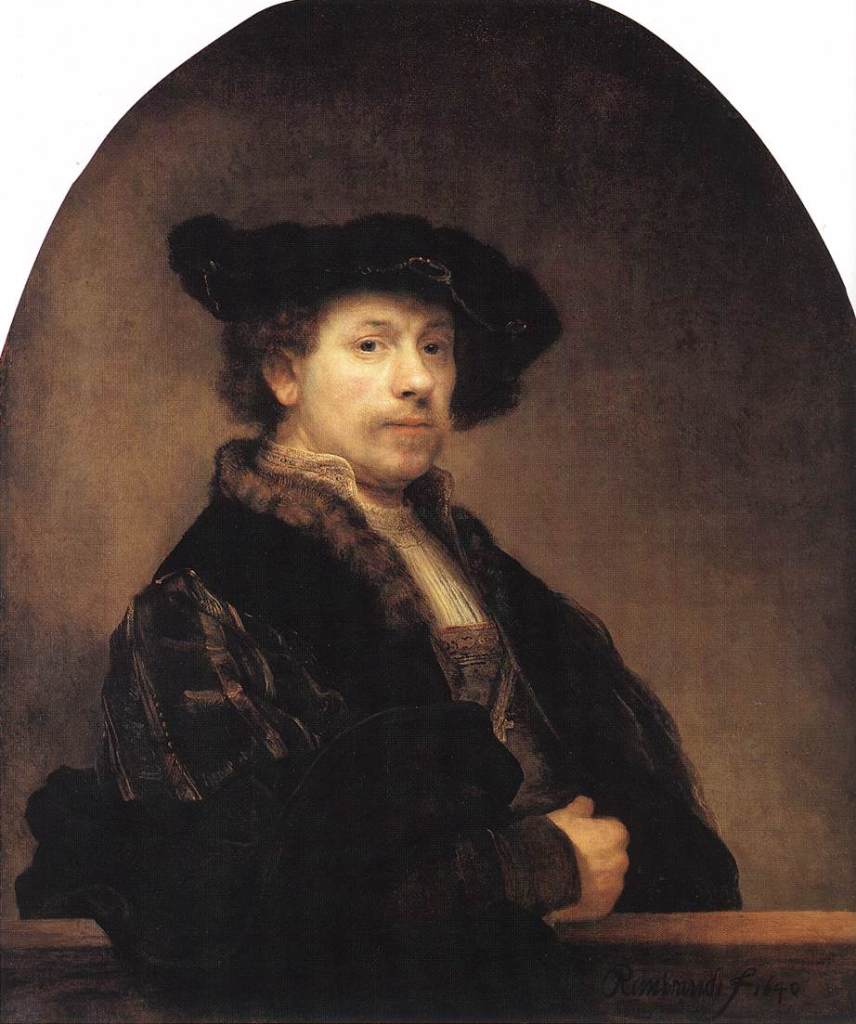
C. 1640 
C. 1660 
C. 1669
Pablo Picasso 1881 – 1973
Pablo Picasso, a 20th century spanish artist who was highly influential in the art world. Picasso produces works in multiple medias and is known for inventing the cubism movement alongside Georges Braque. He is also known for inventing constructed sculpture and involved in developing collage art. He created more than 20,000 paintings, drawings, sculptures, ceramics and theater arts.

I have chose to focus on this painting because it is less noticeable the artist, Picasso. This is an example of the looseness and boldness in the cubist style but has a lot less straight edges than normally seen. Picasso has created visible tonal qualities throughout this image which add to the realistic depiction of himself. Overall I believe the feeling is down to interpretation, His lip crease has a slight smile and he is sitting face on which feels very natural. I think considering it’s overall looseness that is what Pablo wanted the viewer to do, interpret the images meaning.

A very early painting by Picasso, he was 20 years old. This painting marks the start of Bacon’s ‘Blue Period’ where he used social outcasts and the poor as his influence. A very cold painting, blue is prominent throughout except in his lips and beard. This young Picasso looks pale and almost sick. That makes me question if young Pablo was struggling. This image offers great likeness to Picasso and is said to be influenced by Van Gogh. As a comparison to the self-portrait above this is 63 years earlier, a few years before his work took a notably looser, freer style such as cubism and collage art.
Francis Bacon 1902 – 1992
One of the most well known British artists, Francis Bacon. His figurative style focused on the human form and his subjects included crucifixions, portraits of popes, self-portraits, and portraits of close friends. Bacon created 43 self-portraits and his distinctive features such as his wide, round jaw and full pink lips are visible throughout. Francis Bacon created self-portraits as a response to people around him dying and needing a model.

Oil on canvas 66 x 55 in. (152.4 x 140 cm)
This self-portrait is actually not just a self-portrait but also a portrait of Bacon’s friend Lucian Freud. We know this now as Bacon liked to work from photographs and in the images the body is clearly Freud as is the head clearly Bacon. Why did he create this image and title it a self-portrait? perhaps he felt intertwined with Lucian. Or maybe he was envious. I watched the documentary below which allowed me to see that others view this image with the same questions. Perhaps that is exactly what Bacon wanted. Whatever the reason, the images is pleasing. The blue/violet colour compliments the pale yellow/orange colour allowing the focus to be directed to the figure and head. The black box makes me think of a blank void, an empty space and a black hole. That makes the image feel as though Bacon has lost his identity .

Oil on canvas 14 x 12 in. (35.5 x 30.5 cm)
A beautiful example of the figurative style Bacon is best known for. It shows Bacon’s features in true likeness and allows his face to be seen, including the lines created with age around his nose, eyes and forehead. The dark background makes the use of almost fingerprint looking marks in blue around the lips and nose bridge stand out.
References and research
Chilvers, I., 2009. The Oxford Dictionary Of Art & Artists. 4th ed. Oxford: Oxford University Press.
Van Gogh Museum. 2020. Van Gogh Museum – Hét Museum Over Vincent Van Gogh In Amsterdam. [online] Available at: <https://www.vangoghmuseum.nl/> [Accessed November 2020].
Frida Kahlo: 100 Paintings Analysis, biography, quotes & art [ONLINE] https://www.fridakahlo.org/ [Accessed November 2020]
Web gallery of Art [ONLINE] https://www.wga.hu/html_m/r/rembrand/27self/index.html [Accessed November 2020]
Francis Bacon [ONLINE] https://www.francis-bacon.com/ [Accessed November 2020]
Evolution of Picasso’s Iconic Self-Portraits From Age 15 to 90. 2016 Kelly Richman-Abdou. My Modern Met [ONLINE] https://mymodernmet.com/pablo-picasso-self-portraits/ [Accessed November 2020]
Expressing Oneself With Self Portraits. Wasim Ahmad. EzineArticles.com [ONLINE] https://ezinearticles.com/?Expressing-Oneself-With-Self-Portraits&id=2507960 [Accessed November 2020]
Portrait of an artist 2019 [ONLINE] Simon Kreitem. Lonelyleap [Accessed on 9 Nov 2020 at https://www.amazon.co.uk/Portrait-artist-Aleah-Chapin/dp/B07V4TH3M4/ref=pd_ys_iyr9%5D
 B-log
B-log 